I read this book in fourth grade when I went through my Judy Blume phase. All my friends who hadn't yet started their periods raved about Are You There God, It's Me, Margaret but to someone like me with precocious puberty, Margaret was passé. Starring Sally J. Freedman as Herself was my favorite Judy Blume novel.
I remember really identifying with the main character, a ten year old girl who leaves behind her beloved father in New Jersey to move with her mother and grandmother to Florida. I could relate: half of my beloved family stayed in St. Joseph MO while the other half moved to Kansas City when I was six. It comforted me that my feelings of loss and loneliness were not weird, but something that other kids my age go through when their family breaks up.
It felt like I had so much in common with this fictional Jewish girl from the East Coast in 1947, even though I was a Christian girl from the Midwest in 1981. That's a testament to Blume's strong characters and storytelling. I'd recommend this classic to anyone.
I'm a teeny, tiny bit obsessed with the Myers-Briggs Type Indicator. (I'm an E/INFP.) A bit like my 14-year-old self was obsessed with astrology. (I'm a Scorpio with a Virgo moon and a Libra rising sign.) It might be a bit ridiculous to lump complex human beings into personality types, but it fascinates me.
I recently gave our soon-to-be nine-year-old, Katie, the MBTI test. The test is designed for adults, so I had to explain some of the big words and complex questions, but she had fun taking the test. She's an INFP. And a Cancer with a Taurus moon and a Taurus rising sign. OK. Maybe I haven't ever gotten over my silly obsession with astrology.
My husband Will must adore me. He is totally not the type of person who digs personality tests like I do, but he took the MBTI test to satisfy my curiosity. He's an ISTJ. And an Aquarius with a Virgo moon and a Pisces rising sign.
I found this awesome website that visually interprets each individual Myers-Briggs type. I decided to use it to create an MBTI Type Family Tree.
*Note, I'm guessing my dad's type. I've never had the guts to ask him to take the test. He thinks psychological stuff is weird hippie crap and I'd like to save my energy for a more important battle with my dad than one over whether or not he'd agree to take a personality test. Which explains why my guess is that Dad's an ESTJ. And an Aries with a Virgo moon and a Pisces rising sign.
My MBTI Type Family Tree:
Glen Burton, my father: ESTJ*
Glen Burton, my father: ESTJ*
Bev Martinmaas, my mom: ISFP
Bev Martinmaas, my mom: ISFP
Becky Carleton, me: ENFP
Becky Carleton, me: ENFP
Will Carleton, my husband: ISTJ
Will Carleton, my husband: ISTJ
Katie Carleton, our daughter: INFP
Katie Carleton, our daughter: INFP
All these and more MBTI heads are found here. What's your MBTI Type Family Tree look like?
This is a beautifully written book about ugly subjects: sexual abuse, racism, classism, abandonment. Marie is a black girl from a well educated, affluent family. But that doesn't mean everything in her life is happy. Lena is a white girl from a poor family that just moved to town. The trashy side of town--literally--near the town dump. But that doesn't mean everything in Lena's life is shit. Both girls bond over their shared motherlessness, their ability to see the good in bad situations, and their feisty, fierce loyalty and concern for each other. In another writer's hands, the two girls, their schoolmates, their parents could have easily become caricatures, stereotypes in a "social issues" book, but Woodson treats them with the dignity and respect they deserve, fleshing them out into fully realized individuals who will stick with me for a long time.
When I was a kid, my grandmother owned a beauty parlor. That's what it was called. Not salon. Beauty parlor. Old ladies would stop by once a week and have their hair washed and set. They'd chit chat with the beauticians (not stylists) and the other ladies getting their hair done. They'd complain about their husbands and children. Brag about their husbands and children. They'd read women's magazines and gossip over celebrities and compliment each other on their blue eye shadow and slimming pantsuits.
It was within these walls that I was taught how to be a lady.
It's unladylike to sit with your legs spread apart. Don't take up too much space.
Fat ladies should wear black. Or navy. Bright colors don't hide your "figure flaws".
If your breasts are bigger than mosquito bites, you must wear a bra.
If your legs are covered with spider veins, you must not wear shorts in public.
If your legs are covered with hair, you'll never attract a man. Ladies shave. Everything but their head-hair. And that must be long. Unless you're over the age of forty. Only young ladies can get away with long locks.
Ladies who don't paint their face before they go out in public, or before their husband gets home from work, they have let themselves go.
Today, when I saw this photo of myself, I thought, huh, those ladies were totally wrong. I'm forty-four and my long hair looks great. And here I am, no makeup, turning my naked cheek to greet the universe.
Full disclosure: I'm a total music snob. I tend to not like popular music much. Especially popular music that came out during my tumultuous childhood. Late-Seventies/Early-Eighties pop songs are my madeleines. I experience involuntary memories of traumatic childhood experiences every time I hear a goddamn Styx song. That's what I get for growing up in a dysfunctional family that constantly had Top-40 radio playing in the background.
So when I say this is the best version of "Come Sail Away" I've ever heard, I mean it. Nowadays, I generally switch stations whenever this song comes on the radio. Like Lebowski hates the fucking Eagles, man, I hate fucking Styx. But this man, his performance is admirable. This man's version makes me want to keep listening. I love this man's version of that fucking Styx song, man:
Maybe I can finally get over my aversion to Late-Seventies/Early-Eighties popular music by refocusing my thoughts associated with it to this amazing story. Donald "Boone" Gould is the pianist playing in the video above. Gould is a homeless vet who treats the community to a daily five-song set list on the sidewalk pianos provided by Sarasota Keys Piano Project on Main Street in Sarasota, Florida. Sly Dylan posted a video of Gould's performance on YouTube, and it instantly went viral. Here's the interview Dylan posted the morning after, when Gould was informed that a video of his performance had 100,000 hits in one day. Fans quickly set up a GoFundMe campaign for him.
Next came an interview with ABC7 in which the reporter states that a local piano bar, Surf Shack, has offered Gould "a tryout as a potential act".
Aww! Everybody loves a potential happy ending!
But Gould's story is not a completely happy one, as no good stories ever are. As the great Bob Ross said, "you need the dark in order to show the light."
This is why I like this man's version of the fucking Styx song, man. I can relate to his story, and to his telling of it.
Most artists I know practice their gifts of artistry for its profound psychological healing properties. I know I do. This blog is my therapy. My mom learned to make potholders when she was in the psych ward. My brother, Pat, taught himself the guitar and played songs with a fervor only passionately damaged individuals understand.
Will and I are getting ready to adopt a child through the state's foster care system. We're preparing for the incredible emotional roller coaster we are about to embark on. We understand that children who have been through our broken foster care system have intense needs--emotional, psychological, spiritual, intellectual, social, and physical--that many other children, like our Katie Bug, children who have not been through our broken foster care system simply don't have. We are psyching ourselves up for this tremendous parenting challenge.
In the courses we are taking as part of the adoption process, we have been discussing how difficult--and important--it is to have empathy for the biological parents. Parents whose custody rights of their own children have been severed. Parents who are expected to hand their own children over to other parents. Can you imagine how difficult that would be? Can you imagine how hurt you must be to lose your own child to The System? Holy shit.
And yet, you hear these stories--real life stories, actual cases from the foster care system. Stories of abuse and abandonment, neglect and illness. Emotional, psychological, spiritual, intellectual, social, and physical abuse done to innocent children. Holy shit.
As an adoptive parent of a ward of the state, you must learn how to have empathy not just for the abused child, but for the abuser, too. It's hard. But it can be done. It helps to remember that most abusers were once abused themselves. How can you parent well when you are suffering?
For example, my brother, Pat. He was abused by our grandmother, and he turned around and abused me when I was very young. Who knows who abused my grandmother? Child abuse runs in families. I spent a lot of time in therapy, reading self-help books, and journaling about my experiences growing up in a dysfunctional family. It helped me to figure out a way to stop the cycle of abuse after I had my own child. I have this constant voice in the back of my head, reminding me to try something different. Do not do to her what was done to you. I have been successful at overcoming early childhood trauma by acknowledging it and wanting something better for my own child.
But what if I hadn't spent all that time in therapy and reading books and pouring my inky heart out onto paper? What if after my tumultuous childhood I jumped into a career in the marines, and when that was over, I jumped into marriage and parenthood? And then something tragic happens. My spouse dies. I'm suddenly without the love of my life. I'm a single parent of an exhausting three year old. How would I cope, stuck in life's murky mess?
I can see how people "lose it". My mom had a nervous breakdown not once, but twice. In the Late Sixties, back when housewives got shock treatments if they disobeyed their husbands. In my early twenties, I swallowed a bottle of Paxil and ended up in the ER, being force-fed some black stuff that summoned the blackness from within me with a vomitous force. Pat's told me stories of times he's struggled with wanting to take his own life.
Mom was lucky. She didn't lose her kids when she lost it. Her mother took them in during both of Mom's hospital stays. And I'm sure the stress of having your daughter in the hospital and taking care of her four young children might make someone "lose it," too.
Pat didn't have kids. By the time he found the love of his life she was past her baby-making days. They both died of alcoholic liver failure within four months of each other.
I didn't have children when I downed that bottle of anti-depressants. What would have happened if I did? Instead, I got my shit together. Oh, don't let me fool you. I have bad days. Lots of bad days. But I also have many good moments within those bad days, and I try to focus on them, which turns them into good days. I also have tremendous social support. I met my amazing husband, Will, who is the more psychologically-balanced yang to my psychologically-scarred yin. Together we've raised our eight-year-old daughter. Together I honestly think we can provide a good home for another child who needs a family.
When the day comes and we finally add a child to our family, I'm going to tell him or her this as often as they want to hear it: Your parents love you. Your parents need help learning how to take care of themselves. It's not your fault that they couldn't take care of you. Now we can take care of you. And we can love you. Your parents can't take care of you, but they love you, too. His GoFundMe campaign page states that Gould is now searching for his 18-year-old son. I hope his adoptive parents have told him his parents love him.
My new boss at the library is awesome. During our weekly staff training, she played this video about vulnerability from Brené Brown's viral TED Talk:
The video left me wanting more, as all good stories do. It inspired me to check out Brown's book, Daring Greatly. I'm just at the introduction, and I've already found a part that resonates with me. I had to stop and write it down. Oh, this is good:
When I first started going to Johnson County Community College in 1989, my plan was to transfer to KU and major in Social Welfare so I could get a job working with sexually abused children. I ended up dropping out and working at the library, later going back to get my AA degree so I could become a paraprofessional librarian.
I ditched my plan to become a social worker for a few reasons. I needed to get a job to pay my rent and buy groceries and put gas in my car, and I couldn't figure out how to do those things and go to school at the same time. I also needed time to get my own shit together before I could attempt to help other people get their shit together. My teens and early twenties were the most emotionally unstable parts of my life. It was too draining to spend my days pretending to know how to help others when I spent my nights sobbing in bed at home.
I also knew, deep down, that I'd be a terrible social worker. I'm too passionate and hot-tempered. Our social welfare agencies are chronically underfunded and too wrapped up in bureaucratic bullshit to be able to fully help people change their lives for the better. There's no way I could work in such a broken system. Seeing hurt people hurts me. I'm sure I'd freak out some day and try to "rescue" as many kids as I could, holding them hostage at my house until I realized I'd have to feed them. Then I wouldn't have a clue what to do. I'm about as far from a domestic goddess as you can get and my financial planning skills are about as good as you'd expect from a social worker type. We'd run out of boxed macaroni and cheese and canned peas and I'd have to call the agency I'd kidnapped the kids from for assistance.
I'd boss the parents around and try to tell them what to do with their lives instead of sitting back patiently and letting them figure it out for themselves. I can barely stand to listen to my friends complain about their lives without wanting to slap them, shake them, and scream at them for not listening to my advice the last time we talked. I'd be a terrible social worker.
I went to work at the library because I believe in the healing power of books and ideas. So many books have changed my life that I feel compelled to share my discoveries. I want to help other people find books that can change their lives for the better too.
As a librarian, I get to recommend books that enrich people's lives. But I'm not a social worker. I'm not actively involved in the daily lives of the people I help. I have no idea if they actually read the books I recommend. I have no proof that the books I recommend change anyone's attitudes and behaviors. I have no guarantee that the ideas I'm slinging will fix anyone's problems. And that's good. For an emotionally damaged control freak like me, it's good that my job is not to fix other people. If I were busy all day trying to fix other people, I'd have no time to work on myself, the one person who needs my attention the most. If I've learned anything from the many books I've read over the years it's that the only person's behavior I can control is my own.
By being a librarian instead of a social worker I get to step out of other people's messes, other people's crazy, and the dysfunction of other people's daily lives. My job is to provide resources for people who wish to learn how to empower themselves. The best way I know how to test those resources is to try them out myself.
Here are a few of my favorite "self-help" books. I expect to add a Brené Brown book to it in a bit. I couldn't even get past the introduction without being inspired to write this blog post.
When I was sixteen, my dad gave me a laminated quarter and told me to keep it in my wallet. This was back in the dark ages before cell phones. There were payphones all over the city. Drop in a quarter and make a call.
When dad gave me the laminated quarter he said, "My buddies and I used to do stupid things when I was your age. Here's a quarter. Call home if you're ever stranded somewhere drunk and you don't have a ride home."
My dad and I have the weirdest relationship. When I was growing up, Dad was both incredibly controlling and surprisingly lenient. I had no curfew. I had no restrictions on what movies I could watch or what books I could check out from the library. I could talk openly about sex if I wanted to around my dad, although I never wanted to. Yuck. I reserved sex talks for my mom.
When I was a little kid I could leave my toys all over the place and Dad never yelled at me to clean up my mess. My friends would come over to our house to play Barbies because we could leave our doll furniture out in our living room all summer long, without having to tear it down and pack it up at the end of the day, only to have to unpack it and set it all up again the next day.
These were the ways Dad was surprisingly lenient. Surprisingly because, by nature, Dad's default mood is controlling. Before he retired, Dad's title at work was "controller". I asked what that means, and Mom explained it means he bossed the other accountants around in the office and made sure everyone showed up to work on time. Yep, that sounds like the perfect job for Dad.
It wasn't just at work. At home, Dad wasn't just a boss, but the king. Dad's the kind of guy who has a temper tantrum if he doesn't get his way. Everything in our daily lives centered around keeping Dad calm. We lived where he wanted to live in a house to his liking, regardless of whether or not it was good for anyone else in the family. We ate at restaurants he picked and saw movies he wanted to see. The first vacation we took was when I was nine and we drove to St. Louis. Dad wouldn't pay for us to go up in the arch. I once asked Dad why we didn't go on many family vacations. I knew he'd been to Europe after the war and that he'd traveled all over the country on road trips with his first wife and daughter. "Why don't we ever go anywhere, Dad?" I asked. "Eh, my traveling days are behind me," is all he'd say.
There were other, sillier, but still controlling things. I wasn't allowed to drink the canned pop we kept in the fridge. That was reserved for Dad's sack lunch. I wasn't allowed to sit in the comfy chair in the living room. That was reserved for Dad's hard working ass. But it was also important, philosophical things. I wasn't supposed to disagree with Dad on anything--politics, religion, how often I should mow the lawn, although by the time I was sixteen I discovered that I could actually hold my own in a shouting match. I stopped running off to my room and crying every time Dad raised his voice. I fought back.
It felt great. Letting my voice be heard improved my self-esteem. I felt courageous and strong. Not like Mom, who avoided confrontation at all costs. Even, in my opinion, at the cost of herself.
Arguing with him did nothing for my relationship with Dad, though. It did worse than nothing. I couldn't wait to get out of the house and away from him.
I used to hate Father's Day. I remember once, in my twenties, I had to leave the store because I was starting to cry. I had spent thirty minutes in the Father's Day card aisle and found absolutely nothing I could relate to, nothing I could buy for my own dad. This one was too sappy. This one too funny. This one made our relationship sound better off than it was. This blank one, even. No. What would I write it in? "Happy Father's Day, Dad. Thanks for waiting until I was eighteen before kicking me out of the house!"
Then time happened, as it does. I grew up. I learned to stop shouting and start voicing my opinion in a calm, rational and empathetic way. Dad and I both went on anti-anxiety medication. The wonder drug that works wonders on our father-daughter relationship. I no longer feel distraught when I visit the Father's Day card aisle.
Today my eight-year-old daughter Katie sat at the table and asked me a question that was important for me to answer, not just for her, but for myself. She was drawing a picture of herself on a card she was making to give to my dad for Father's Day. She asked, "Mom, why do you think your dad was mean when you were a kid, but he's not mean anymore?"
"Oh, Punk. It's a lot of reasons. He had a hard life when he was growing up. And he's experienced a lot of sad things in his life that made him mad. And he didn't know how to not take out his anger on his family. But now we don't see him much, and he's old and he's calmed down. And he takes meds that help him stay calm. And so do I. And I've grown up. And we're just, you know, OK now."
"Yeah," Katie said without looking up from the picture.
We visited my dad and, you know, it was OK. He said some things that annoyed me, but so what? I see my dad a few times a year. Big deal. I can ignore his annoying bits for that short amount of time.
It's just funny to me that my daughter is growing up with this idea in her head that my dad is a pretty OK guy. She didn't know him when he and I would shout at each other in high school. She wasn't there to see him call my mom "stupid" and to kick me and my siblings out of the house. She only knows this calm old man who likes to dance and play bridge and eat pie. He's just some mellow old man who's not so hard to love.
And it's good for me to be reminded of it too. Dad was never all bad. He once offered to come pick me up if I ever needed him. I still have the laminated quarter to prove it.
I'm the storyteller at GCPC VBS for the preschoolers/kindergartners. Tomorrow's story is about Solomon building a temple. For our after-story-activity we're going to play a game of "Is it a tool or is it not a tool?" It goes like this:
Despite appearances, my daughter Katie is not a tool.
What you'll need:
1 shopping bag
12 or so kid-friendly tools (small plastic "play" tools, plastic measuring cups, wooden spoons)
12 or so kid-friendly objects (a small ball, "play" money, random toys from fast-food restaurants)
a bunch of kids, ages 3-6
What you'll do:
Have each kid take a turn pulling one object from the bag, without peeking. Have the kid show the others what it is, and everyone calls out whether or not they think it's a tool or not a tool. The kid decides whether or not they think it's a tool or not a tool. If it's a tool, ask the kid to explain what it helps us do. Have the others help come up with answers. If it's a tool, the kid places it in the laundry basket marked "tool". If it's not a tool, the kid places it in the laundry basket marked "not tool".
Katie let me borrow some of her toys. I also grabbed some kid-friendly kitchen tools.
Katie displays some objects you could use for the game,
"Is it a tool, or is it not a tool?"
This would also be a fun activity for library storytimes, or for parents and caregivers to do with kids at home after reading books about buildings and tools. Here are some of my favorite:
I tried out the "Is it a tool or is it not a tool" activity today (6-2-15) with the three to six year olds at VBS. It was a major hit. I noticed some of the kids who were holding back yesterday wanted to participate today. One boy in particular--I had him last year at VBS too, but I'd never seen him smile until today, and he wanted to do it "again! again!" I'm definitely going to try this game at some library storytimes. Remember, what might seem like a lame game to you might be loads of fun for younger kids.
My main pet peeve about many of the young adult novels I've read is that they don't have strong adult characters. And I get that. Teenagers often don't think of their parents and teachers and other adults around them as interesting, complex individuals. Why would a teenage protagonist bother to flesh out the adult characters in their story? A.S. King's Glory O'Brien's History of the Future is different. Probably because the main character, Glory O'Brien, is different. Actually, she's completely normal, but she feels different. Glory's mother, Darla, committed suicide when Glory was four-years-old. Now Glory is graduating high school, motherless, wondering about her own future, worrying that she'll end up with her head in the oven like her mother. Her dad, a widower these thirteen years, was once a painter but now he slouches on the couch balancing a laptop on his knees while eating microwaved frozen dinners from a plastic tray. It is just as much his story I enjoyed seeing unfurl before my eyes as Glory finds her own way.
Then there's the whole drinking a bat and gaining super psychic powers and writing the history of the future bit. It was surprisingly not difficult to suspend disbelief with this part of the novel. I'd recommend this book to teens and adults who tend to lean toward more realistic fiction, but who want to explore a relatable dystopian fiction book. I'd also recommend it to teens and women dealing with eating disorders or body dysmorphia, and anyone interested in a strong feminist character's point of view.
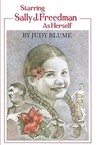 Starring Sally J. Freedman as Herself by Judy Blume


